The Benefits of Reading to Kids at Bedtime: Why It's Worth Every Night
The quietest 15 minutes of the day may be the highest-returning. Here is what a bedtime story gives your child — and you.

Reading to kids at bedtime does far more than settle them down. It teaches them to love reading, grows their vocabulary and listening skills, calms the brain for sleep, opens their imagination, and turns the end of the day into a peaceful way to quietly spend time together.
Ask parents who have done it for years and you hear the same thing: start young, keep it consistent, and the habit keeps paying back — in school, in sleep, and in how well you know your child. Here are the benefits, in their words and in the research.
The Benefits of Reading to Kids at Bedtime, at a Glance
- It teaches a lifelong love of reading. Read to your kids often, especially from a young age, and they learn to love books before school ever tests them on it.
- It builds word recognition. The sooner a child sees a word, and repeatedly sees it, the sooner they recognize it and can tell you what that word is.
- It grows listening and comprehension. Shared reading builds the language and listening skills every later subject depends on.
- It calms kids and eases sleep. Reading relaxes a child and becomes a trigger to go to sleep, helping the brain and body prepare for a better night’s sleep.
- It bonds you. Your child gets to hear your voice, and the two of you get to bond.
- It opens their imagination. Stories open kids up to new ideas and feed their make-believe long after the book is shut.
- It makes you a better parent. Night after night of stories helps you understand your child’s inner being.
It Teaches Your Child to Love Reading
Every other benefit grows from this one: when you read to your kids often, especially if you start at a young age, you teach them to love reading. One father watched it happen from the very first months.
My wife and I have been reading to our son since he was an infant. Long before he could talk he used to grab one of the many books that we had lying around the house and crawl over to us to be read to.
By the time he was two he knew the alphabet backwards and forwards and by the time he was four he was starting to read on his own. He just turned six and he is in Kindergarten but while a lot of the kids in his class are still working on grasping how to sound out the letters he is reading at about a second grade level if not better. Since starting school he has started to read just for enjoyment now. He will sometimes come home with a book about monkeys or dolphins and just put his feet up for a half hour to an hour and read.
My point is that if you read to your kids often, especially if you start at a young age, then you will teach them to love reading. I believe that will put my son way ahead in life. He already loves to read and learn so school is enjoyable for him and I don’t expect that will change anytime soon.
Notice what is missing from that story: any fight about reading. Another family says the same.
We have never had a fight about “reading homework”. As they get older, they will offer to do the reading aloud as a stalling tactic.
That early start lays something deeper than a reading habit. The first stones of a child’s foundation are laid by parents, in the home, long before school adds its weight.
The Sooner They See a Word, the Sooner They Know It
Word recognition is the quiet engine behind early reading, and bedtime is where it gets built. As one parent explains.
The benefits of reading to your child, not only at bedtime, but at other times during the day, is the sooner the child sees a word, and repeatedly sees it, he/she will recognize the word and be able to tell you what that word is. For example, I read the same 12 bedtime story books to my children every night from the time they were 6 months old until they were old enough to talk - pointing at each word as I said it. When they were old enough to talk, I asked them to read to me. Sure, they would get stuck sometimes on a word or two, but for the most part, they did pretty good!
Now, both of my children have graduated from high school but the one class they always excelled in was Reading.
That is not just a parent’s hunch. The American Academy of Pediatrics now recommends shared reading from birth, and its 2024 policy update found that shared reading starting in infancy offers lifelong benefits — strengthening parent-child bonds, stimulating brain circuitry, and building the foundation for language, literacy and social-emotional development.

Photo: Leeloo The First / Pexels
It Makes Bedtime Calmer and Sleep Easier
A bedtime story is one of the most reliable off-switches a parent has. Reading relaxes a child, becomes a trigger to go to sleep, and helps the brain and body prepare for a better night’s sleep.
One more benefit: it will help them to calm down at the end of the day and get ready to go to sleep if not fall asleep while you are reading. A routine at bedtime is really important. It can actually help the brain and body prepare to go to sleep giving them a better night’s sleep. It relaxes them and becomes a trigger to go to sleep. Anticipating certain things can either calm a person or excite them. A routine of relaxing and calming down right before bed will calm them down.
Also if the routine is enjoyable and liked by the child, they will look forward to it as well.
And when the day has been long, the routine bends without breaking. One family’s dinner-bath-story-bed has lasted since the kids were tiny.
It is a baked-in way to make the bedtime routine take longer when the kids are not so tired (extra chapters), or shorter when they need to pass out as soon as they hold still.
The same family’s children have a Pavlovian response of passing out to one particular book.
My kids have a Pavlovian response of passing out to “7 little rabbits”. They have to really want to be awake to make it to the end (holding eyes open with fingers, etc).
Pediatricians recommend the same shape of evening. The American Academy of Pediatrics’ brush, book, bed routine pairs toothbrushing with 15 minutes of reading aloud and a regular bedtime — predictable steps that help a child wind down from the day.
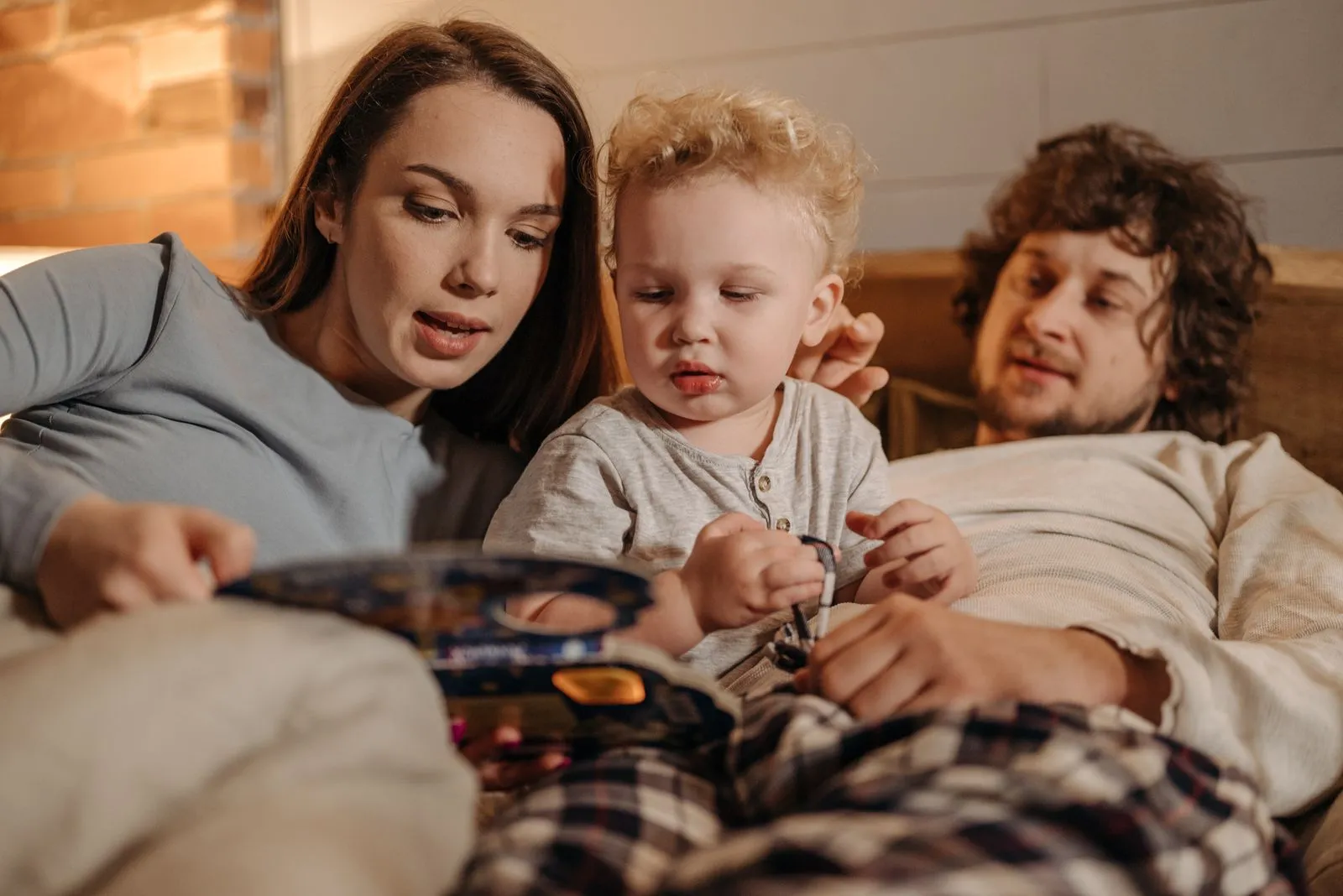
Photo: Pavel Danilyuk / Pexels
It Builds Your Bond — and Helps You Understand Your Child
Bedtime reading is the quietest, closest part of the day — and that closeness is where its deepest benefits show up, for your child and for you.
It is a peaceful way to quietly spend time together at the end of the day.
It allows your child to hear your voice and the two of you to bond.
Educators agree on what reading does for a child. They cite the educational literature with statistics proving that by reading, your child will become a better reader, or your child will develop strong listening skills, or your child will improve their comprehension. Of course this is true. But there is a benefit the statistics miss, as one parent puts it.
But what they miss is the fact that you, as a parent will become a better parent. By reading to your child, you will understand their inner being. You will recognize what makes them sad, what makes them happy, what makes them angry and what makes them want to take on the world.
When you curl up with your child in bed each and every night, and when you choose the story (with the imbedded and subtle meaning you can’t lecture about but can artfully construct) you have the ability to shape the message. You want to develop empathy: Sounder or Ruby’s Story. How about racial sensitivity? Roll of Thunder Hear My Cry. Humane animal treatment? Shiloh. And so it goes.
But more than that, reading to your child on a daily basis or listening to audio tapes (instead of TV videos) connects you to the innermost thoughts of your child. You begin to understand them. You know them. Who knows? Maybe read them like a book! And in knowing your child, you can better maneuver the unknown path ahead.
This is the belief Little’s Guide is built on: every child arrives with a true nature, and understanding that nature comes before shaping it. Storytime is one of the simplest places to practice it. When you observe before you react — noticing which stories light your child up, which ones quiet them, which characters they return to — you learn to read your child a little better every week. If you want to go further, the Decode Your Child journey is built entirely around reading a child’s true nature, without labeling it.
It Opens Their Imagination
Every story you read plants something your child can build with later — even the fictional ones, maybe especially the fictional ones.
It opens them up to new ideas. (yes even reading fictional books to them) It opens up their imagination.
The volume adds up faster than you would think. One family reads more than 300 stories a year.
300+ stories/chapters/etc per year is a lot of content. Even if you read the same things a kazillion times, that is a lot of content to get into their little brains. And some of it will. Watch their make-believe after a story that really catches their imaginations.
The words stick, too — and not only the ones you would expect.
They can recite “The Walrus and the Carpenter” all the way through. With inflection. And both of them dissolve into fits of glee when they recognize a quote in the wild.
That delight is the point. Reading together grows curiosity, memory and a wider understanding of the world — and it gives children language for things they have never experienced. Reach Out and Read, the nonprofit behind pediatric literacy programs across the United States, puts it plainly: children who are read to more often have improved language and listening skills, stronger emotional connections with their loved ones, and a lifelong love of reading.
How to Make Bedtime Reading a Habit That Sticks
You do not need a perfect routine. You need a short one you repeat. Here is what parents and pediatricians agree on.
- Start while they are infants. Every parent quoted here says the same thing: the earlier, the better. One put it simply: “I recommend starting this while they are infants.” A baby who cannot follow the words is still hearing your voice and learning that books mean closeness.
- Match the book to the night. Keep long books for wide-awake evenings and short ones for the end of a long day. As one parent writes: “There are short books and long books. So that if you are exhausted due to your day, you can have your child pick a short book. Or you can depending on how old your child is.”
- Point at the words as you say them. One parent read the same 12 bedtime story books every night, “pointing at each word as I said it,” and later handed the book over: “When they were old enough to talk, I asked them to read to me.”
- Let them choose — and expect repeats. The same book for the tenth night is not a problem; it is the method working. For more ideas, the AAP’s 10 tips to help your child fall in love with reading suggests letting kids pick the book, keeping books within reach, and reading together before bedtime.
- Anchor the story to a fixed sequence. One parent’s example routine: “bath, getting dressed for bed, brushing teeth, and climbing into bed, then getting a story read to them, then lights out and sleep.” And some people would add: “lotion to the skin between having a bath and getting dressed for bed.”
Same time, same order, a book your child chose. The story does the rest.
Conclusion
The benefits of reading to kids at bedtime compound: the child who is read to becomes the child who reads on their own, and the parent who reads becomes the parent who understands. Start young if you can, keep the books short when you must, and let the same story be asked for again and again.
Amen to books.
Reading aloud is one of the small daily habits we return to often. For more long-form insights on child constitution and parenting, browse the Insights library.